What Size Should My Bottle Label Be?
Share
Choosing the right bottle label size is not simply a case of picking a standard measurement.
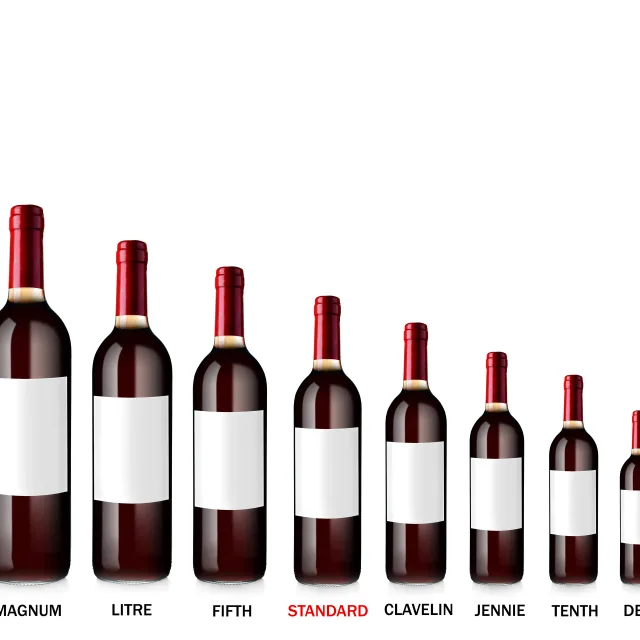
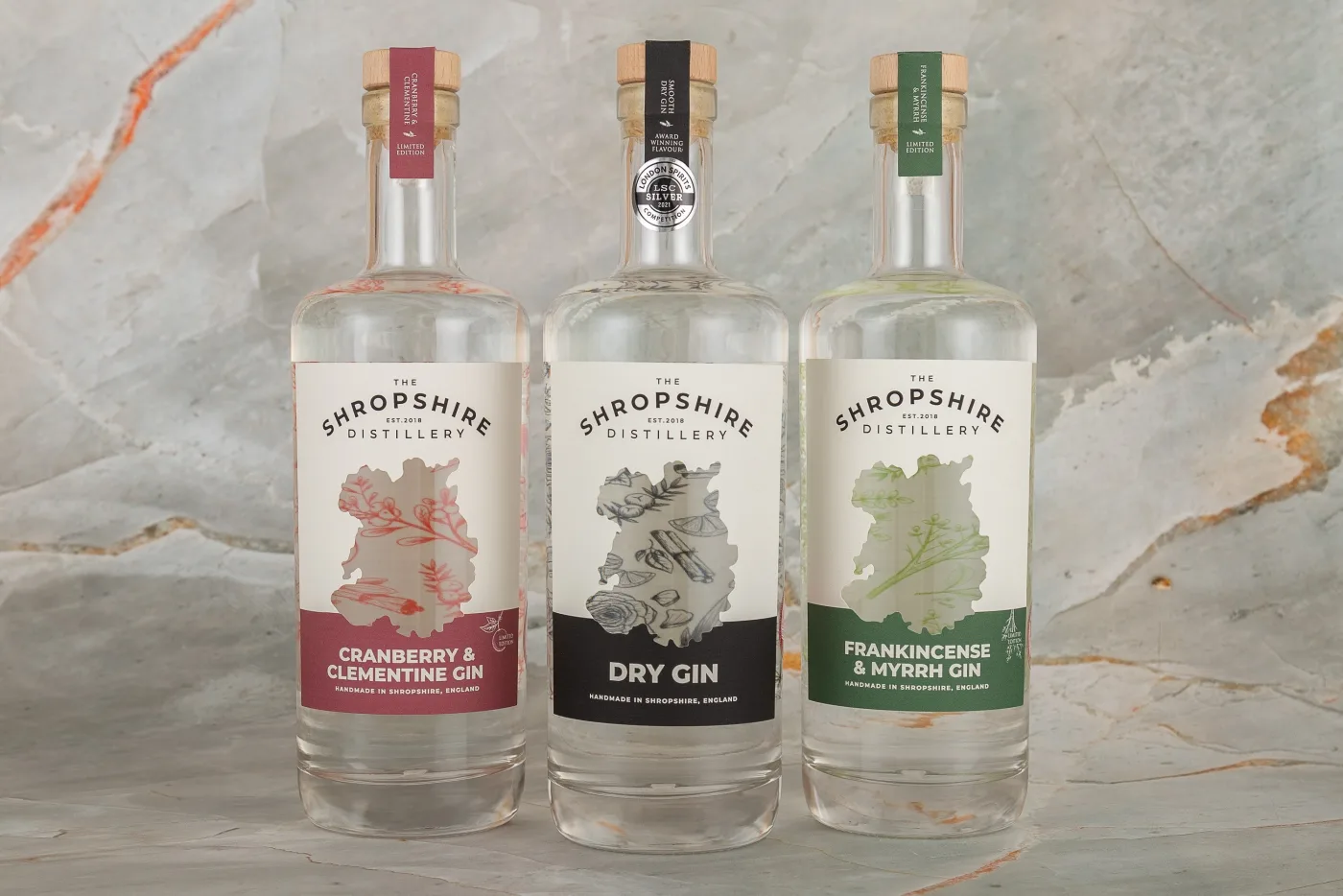
Two bottles with the same capacity can have very different shoulders, curves, tapers and usable labelling areas. A 500ml bottle does not automatically need the same label dimensions as another 500ml bottle.
The actual container should always be the starting point.
Start with the usable labelling area
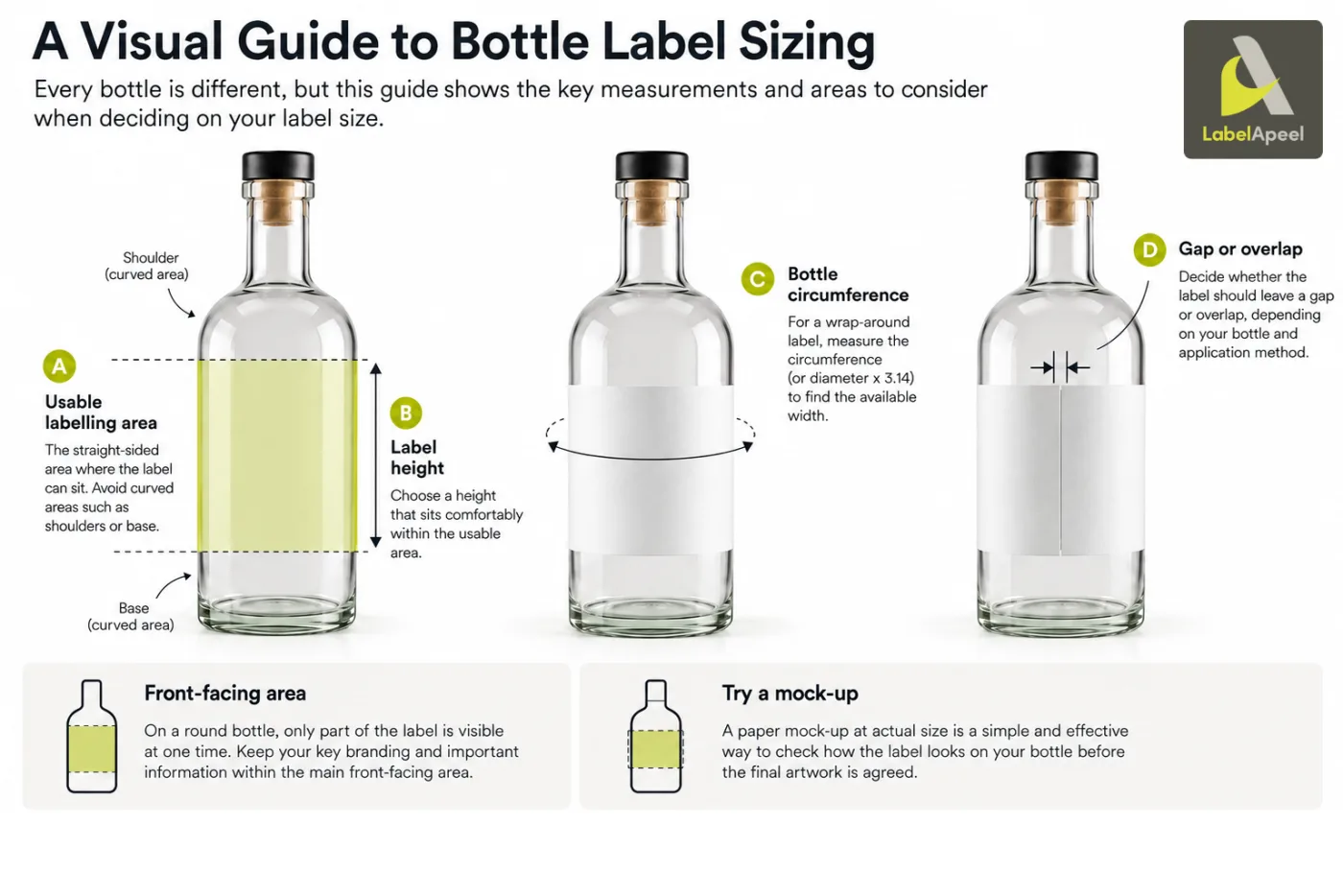
The most important measurement is the straight-sided area where the label can sit comfortably.
If a label runs too far into a shoulder, taper or curved base, it may not sit flat and can be more prone to lifting or wrinkling.
For that reason, it is better to work from the actual bottle, accurate technical drawings or a physical sample rather than choosing a label size from the bottle capacity alone.
If you are still developing the artwork, a full-size paper mock-up is also a useful check. It quickly shows whether the proposed label feels proportionate to the bottle and whether it is getting too close to any curved areas.
How wide should a bottle label be?
For a cylindrical bottle, the circumference gives you a useful starting point.
You can measure it directly with a flexible tape or calculate it by multiplying the bottle diameter by approximately 3.14.
From there, the label width depends on how much of the bottle you actually want to cover.
A wrap-around label might leave a deliberate gap between the two ends, overlap slightly, or cover only part of the circumference.
So, use the measurement as a starting point, but check the proposed size against the actual pack before the artwork is finalised.
Make sure the label has enough room to do its job
Label size is not only about what fits physically on the bottle.
It also needs to accommodate the information the product has to carry, such as branding, ingredients, product details, barcodes, instructions and regulatory information.
If everything starts becoming compressed, simply increasing the front label size is not always the best answer.
A separate back label, reverse-side printing on a clear label, or a peel-and-reveal construction can create more space without overcrowding the main design.
Reverse-side printing can extend the artwork or introduce additional detail through the bottle, while peel-and-reveal labels are better suited when significantly more room is needed for ingredients, instructions, regulatory information or multilingual content.
Think about how the label will be applied
Application can affect the final label size and shape too.
A label being applied by hand gives you more flexibility than one running through an automatic applicator or bottling line.
For machine-applied labels, it is also important to know which edge of the label needs to feed first (the leading edge). Depending on the applicator, this may be the top, bottom, left or right edge.
You do not need to determine these details yourself, but they should be confirmed with your printer or applicator before the final artwork and roll specification are agreed.
Shaped labels can use the bottle differently
A label does not have to fill the available rectangular space.
A custom die-cut can follow the artwork, reveal more of the glass or deliberately use the bottle itself as part of the design.
This can work particularly well where a conventional rectangle feels too heavy or where the shape of the container gives you an opportunity to do something more interesting.
The same practical rule still applies: the shape needs to sit within the usable labelling area and apply reliably.
There is no single standard bottle label size
Standard dimensions can be useful during early design work, but they should only be treated as a starting point.
The final size should be based on:
- the actual bottle
- the usable straight-sided area
- how much of the container you want to cover
- how much information the label needs to carry
- whether the label is applied by hand or machine
- whether a shaped, reverse-printed or peel-and-reveal construction would work better
That is why we would rather look at the bottle and the intended use than simply recommend a standard size based on capacity.
Not sure what bottle label size to use?
You do not need to arrive with the final dimensions already worked out.
If you are developing a new pack, get in touch and send us the bottle specification, dimensions or a physical sample along with the artwork you are working with.
We can look at the available labelling area, how the label will be applied and what the design needs to accommodate before the final size is agreed.
It is much easier to resolve those points early than to discover later that a label which works on screen does not work quite as well on the bottle.
Request a Quote
Tell us a little about your label requirements and our team will prepare a tailored quote. If we need any extra information, we’ll be in touch before sending it over.