Embossed Labels vs High-Build Screen: What’s the Difference?
Share
An emboss and a high-build screen are both excellent ways to add height and texture to a label. Because both create a raised effect, they can be confused or treated as interchangeable finishes. However, they are produced differently, suit different label materials and design objectives, and create a different look and feel.
How are embossed labels created?
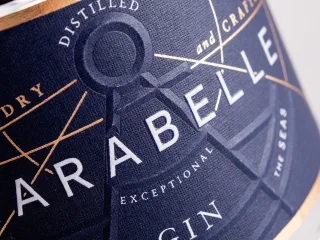
An emboss is created by physically shaping the label material using a matched metal tooling set. The label is pressed between the embossing tool and counterforce, moulding the substrate into a raised form.
Because the material itself is being reshaped, embossing only works on paper-based stocks. Paper contains fibres and, particularly in thicker or more textured papers, there is more structure to compress and form into a raised detail. Plastic films are unsuitable for embossing because their elastic nature means they tend to recover towards their original flat form.
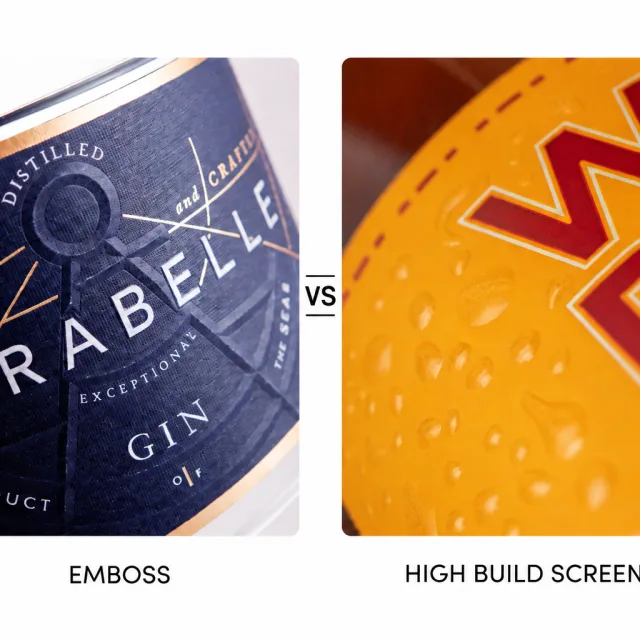
An emboss is usually a subtle, tactile finish. You can feel the raised detail when you run a finger across the label, but its visual effect often depends on light and shadow. In bright, even lighting, the emboss may appear understated. When the light catches it from an angle, the depth and detail become much more noticeable.
It is also worth considering that an embossed area can be pressed flatter over time, especially if the label is handled frequently, packed tightly or subjected to pressure during application and distribution.
What is high-build screen?
High-build screen is a thick, clear varnish applied selectively to chosen areas of the label. It is then cured using UV light, creating a solid raised finish that sits on top of the printed material.
Unlike embossing, high-build screen does not rely on physically shaping the substrate. This means it can be applied to a much wider range of label materials, including papers and plastic films.
Once UV cured, the varnish retains its height and cannot be flattened in the same way as an emboss. It is therefore a particularly practical option where durability, handling or consistent raised detail are important.
High-build screen also creates a noticeably glossy finish. As the label moves in the light, the varnished areas catch and reflect it, making the raised feature more visually prominent than a traditional emboss.
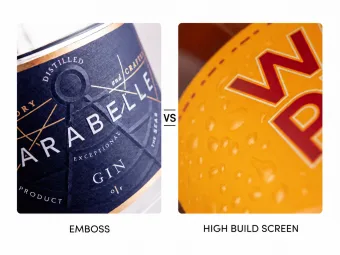
Here’s a quick side-by-side comparison of emboss and high-build screen, covering the main differences between the two:
| Emboss | High-build screen | |
|---|---|---|
| How it works | Physically shapes the label material | Raised UV-cured varnish sits on top |
| Materials | Paper only | Paper and plastic films |
| Look | Subtle, shaped by light and shadow | Glossy and more visually noticeable |
| Feel | Raised, tactile material | Solid, smooth raised varnish |
| Durability | Can flatten under pressure over time | Retains its height |
| Best for | Refined, traditional and tactile finish | Stronger visual impact and contemporary appearance |
Which finish should you choose?
Choose an emboss when you want a refined, traditional and tactile finish on a paper label. It is especially effective for premium brands where the customer is likely to hold and inspect the product, such as wine, spirits, luxury foods, candles or high-end cosmetics. An embossed logo, crest or brand mark can add quality without overwhelming the overall design.
Choose high-build screen when you want a stronger visual effect, a glossy raised feature, or when your label is produced on a plastic material. It is ideal for making selected elements stand out, such as a brand name, pattern, illustration, icon or product descriptor. It can also be a useful way to add tactile interest while retaining a crisp, contemporary appearance.
Thinking of adding more texture and depth to your labels?
At Label Apeel, we can help you choose the right finishing technique for your design and material. Whether that’s emboss or high-build screen, we’ll guide you towards the option that works best for your label. Get in touch today and let’s talk through your project. Or, if you’d like to see these finishes up close first, order a portfolio and take a closer look at our emboss and high-build screen samples.
Order a Portfolio
Complete the form and we'll send you a portfolio of some of our best work.